
The physical and economic violence suffered by indigenous women traps them in an oppression that forces them into a constant struggle for survival. Preoccupied with satisfying their primary needs, they are deprived of the space they need to get to know themselves and to question their well-being, in particular by using their femininity as a vehicle for emancipation.
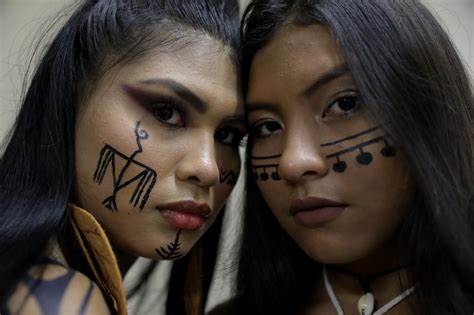

Indigenous populations are often perceived as marginal, living outside the dominant norms. Yet indigenous women are the guardians of a culture and tradition that they strive to pass down from generation to generation. Over the years, they have had to contend with increasingly unprotective policies that threaten not only their fundamental rights, but also their heritage. One of the greatest dangers they face is the growing insecurity of their right to land, which is guaranteed by the Brazilian constitution and recognised by several court rulings. But in the face of economic pressure, this right is increasingly being challenged. Large industrial companies, backed by the government, refuse to respect the protection of indigenous territories and covet their natural resources.
It is in this struggle that violence intensifies. These women lead a way of life deeply rooted in the traditions of their ancestors, a way of existing that clashes with capitalist logic. In these societies, difference is only tolerated when it is profitable. To be a woman is already to face discriminatory norms and policies, even when they are not openly directed against us. Oppression is a weight that we are taught to carry, to integrate until we accept it as inevitable. But while all women suffer violence, it does not always take the same form.
Because of their marginalisation, indigenous women are doubly exposed to oppression. Those who try to adapt to the rules imposed by society encounter physical, mental, sexual, psychological or economic violence, whether conscious or unconscious, which I will explain in more detail shortly. But those who refuse to conform and defend an alternative way of life face even more ferocious violence. By protecting their land, they stand up to industrial and political giants. By preserving their environment, they stand up to the destructive logic of profit. And by asserting their identity, they refuse to be invisible.
Their marginalisation is not limited to the direct violence they suffer, particularly during heated confrontations with industrialists to take away their land and prevent them from returning to it. They also face economic dispossession that prevents them from living in dignity. Dependent on traditional agriculture, their livelihood is threatened by urbanisation and the destruction of their environment, particularly by the construction of hydrocarbon dams, the cornerstone of the country’s industrial activity. But economic violence is often underestimated, because it doesn’t always leave visible traces. Yet it deprives these women of their autonomy and increases their vulnerability. And when this economic violence is combined with physical violence, the priority becomes survival. We then learn to accept the unacceptable, not because it is normal, but because the human mind, overwhelmed by shock and repetition, eventually resigns itself to it.
Being a woman often means being conditioned never to put yourself first, always to think of others before yourself. But when violence is omnipresent, it becomes almost impossible to realise the extent of the oppression suffered. I’ve always wondered whether their dress and make-up are not, in fact, an affirmation of a femininity that is culturally unique and identifies them, a creativity inherited from their ancestors, emphasising an aestheticism that disturbs as much as it attracts the eye. And what if this expression of femininity was, in fact, a form of identity preservation, a means of preserving an existence of its own that doesn’t fit into the dominant codes, but remains a femininity in its own right.
Femininity is much more than an appearance: it’s part of an identity journey, a process that builds self-esteem, confidence and inner well-being. But how do you reclaim your image, your place, your identity, when existence itself is a struggle? These indigenous women don’t even have the space to think about themselves, because every day is dedicated to survival, to defending their land and their culture against the violence to which they are subjected. They are deprived of a fundamental right: the right to discover themselves and to exist fully, beyond resistance, to discover the power that lives in their femininity.

 Sunshine Empowerment
Laisser un commentaire