
The idea that a feminine woman cannot be intelligent is a way of guaranteeing the reductive idea that femininity is superfluous and weakens the capacity to express pertinent and constructed intellectual reasoning because a beautiful, kind and intelligent woman is something inconceivable in society.
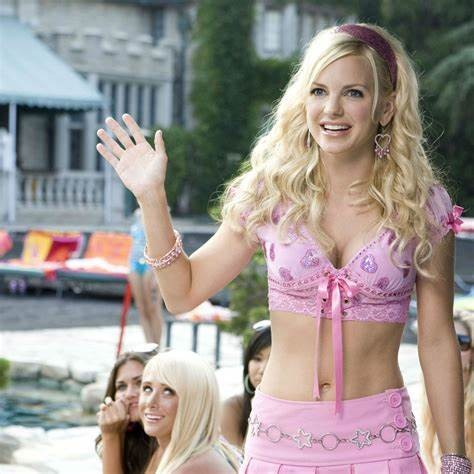

With her dazzling smile, flamboyant blonde hair and body sculpted by rigorous discipline, Shelley is the embodiment of hyper-femininity in Superblonde. Her style, both sexy and girly, is reflected in brightly coloured outfits and imposing accessories, reflecting a particular attention to aesthetics. Yet this expression of femininity is immediately perceived as superficial by those around her, reducing her personality to an appearance deemed frivolous. But this aesthetic is not insignificant: it reflects an identity that society struggles to accept.
Shelley is gentle, smiling and sociable. Her interests revolve mainly around aesthetic well-being, a passion that is often scorned because it does not fit into the fields traditionally considered “intellectual”. She doesn’t feel the need to justify her worth with sophisticated language or academic references. Yet her appearance alone is enough to label her a ‘scatterbrained’ woman, as if her intelligence had to be expressed through socially recognised and validated codes.
This contempt does not only come from men: it is also shared by some women, who are convinced that exaggerated femininity is a submission to patriarchy. The prevailing idea is that a woman who attaches importance to her appearance can only be at the service of male desire, and that she is thus sacrificing all personal ambition. This perception stems from an internalised misogyny that reduces women’s choices to a single alternative: seduce men or try to look like them in order to be taken seriously. In both cases, women cannot exist for themselves.
Faced with these contradictory injunctions, Shelley gradually gives up her identity. She adopts a more neutral attitude, trying to erase what made her a visible, striking woman. This denial is a form of insidious violence that is omnipresent in society: the violence that pushes women to play down their femininity in order to be judged as competent and intelligent. In the professional world, this pressure is blatant. With a few exceptions, working environments are built on a masculine vision of seriousness and rigour, leaving little room for overly assertive expressions of femininity.
Shelley is the perfect embodiment of the triple thread: beautiful, kind and intelligent. And that is precisely why she is despised. As if, in the collective unconscious, a woman possessing all these qualities were necessarily unreal, too perfect to be true. It becomes inconceivable to accept this reality, so we prefer to refute it by creating the idea of a well-hidden flaw that would allow us to ‘see more clearly’ about her. This contempt is reinforced by aggravating the slightest of her faults, by magnifying every imperfection or error, as if to prove that she cannot really combine all these qualities. At all costs, she has to be brought down to a more “human”, more accessible level, as if her mere existence threatens the balance of everyone’s insecurities.
What’s more, in a patriarchal society based on the idea that a woman cannot exist on her own, it is inconceivable that she can shine without benefiting others, directly or indirectly. A woman is not supposed to exist for herself, let alone shine by her very presence and her own qualities. Her existence must necessarily serve a framework, a structure, a hierarchy. When a woman embodies several valued qualities while remaining independent, she escapes this logic and becomes a disturbing anomaly. She doesn’t fit into any easy-to-decipher box, and to make her more graspable, more attainable, we naturally mistrust her. This mistrust is simply a reflection of the insecurities projected onto these women, like an unconscious refusal to accept that they can exist fully for themselves, without external justification. It’s as if a woman who possesses several qualities is necessarily suspect, because we’ve been taught that feminine perfection must always hide a downside.
Shelley is us. We, the women who, consciously or unconsciously, try to conform to a more acceptable image. Because a woman who embraces her femininity is all too often judged as a lightweight, we end up turning our backs on an essential part of ourselves, a source of wellbeing and fulfilment. Society sees femininity not as an asset in itself, but as a mere embellishment. What if the power you hold lives in your femininity?

 Sunshine Empowerment
Laisser un commentaire